
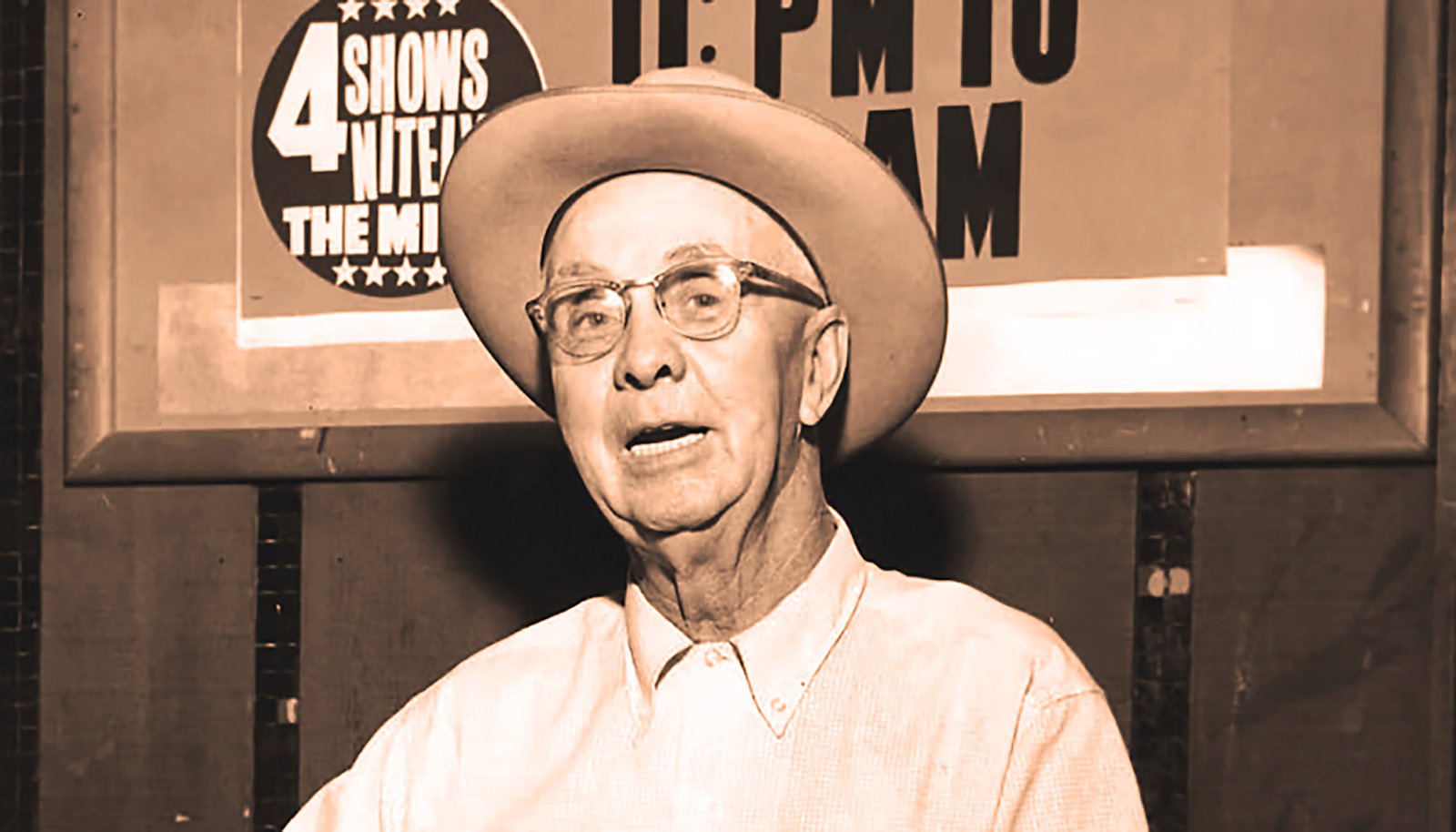
Ernest "Pop" Stoneman: From Fries to the Birth of Country Music
A Virginia mountain musician who became one of the first country music stars — and whose story begins in the New River Valley.
Introduction
Before Jimmie Rodgers yodeled, before the Carter Family sang by the firelight at Bristol, there was Ernest "Pop" Stoneman — a carpenter and musician from the mountains of Southwest Virginia who walked into a recording studio in 1924 and changed American music forever.
Stoneman's story is inseparable from the landscape of the New River Valley. He grew up near Galax, Virginia, recorded songs about the New River railroad, and was directly inspired by Henry Whitter, a mill worker from Fries, Virginia, who showed that a working man from these mountains could make records that sold across America.
Today, the rail corridor where trains once carried this music out of the mountains is preserved as New River Trail State Park. Walking or cycling that trail, you travel through the very landscape that shaped one of country music's founding figures.
A Musician from the Mountains Around Galax
Ernest Van Stoneman was born on May 25, 1893, in Carroll County, Virginia — a rural county whose seat borders the town of Galax. He grew up in a musical family and learned to play autoharp, banjo, guitar, and harmonica from an early age, absorbing the old-time ballads and dance tunes that were the soundtrack of Appalachian life in the late nineteenth century.
The mountains around Galax had been a musical crossroads for generations. Scots-Irish settlers had brought fiddle tunes, English settlers had brought ballads, and the communities of the New River Valley had woven these traditions into something distinctively their own. Stoneman grew up immersed in this tradition, and he had an extraordinary ear — a gift for remembering songs and the ability to play them with infectious energy.
As a young man, Stoneman worked as a carpenter. Music was his passion but not, yet, his livelihood. That was about to change because of a chance connection to a textile mill town on the banks of the New River.
Pop Stoneman's Connection to Fries, Virginia
Fries, Virginia is a small mill town at the southern end of what is now New River Trail State Park. In the early twentieth century, it was dominated by the Washington Mill — later the Fries Manufacturing Company — a massive textile operation that employed much of the local workforce.
Among those mill workers was a musician named Henry Whitter. And it was Whitter's example that set Stoneman on the path to recording stardom.
The connection between Stoneman and Fries is not just biographical — it is musical. Stoneman recorded "New River Train," a traditional song directly referencing the Norfolk and Western Railway that ran through the New River gorge. That same railroad corridor, running through communities like Fries, Galax, and Draper, is today preserved as the 57-mile New River Trail.
Henry Whitter Changes Pop Stoneman's Life
In 1923, Henry Whitter — a mill worker from the Fries area who played guitar and harmonica — traveled to New York and recorded for Okeh Records. His recordings of "Wreck on the Southern Old 97" and "Lonesome Road Blues" were among the first commercially released country music recordings, preceding Jimmie Rodgers and the Carter Family by four years.
When Stoneman heard that Whitter had recorded and was being sold on record, he was astonished and inspired. If a working man from the mill towns of the New River Valley could make records, so could he. In 1924, Stoneman wrote to Okeh Records and arranged a recording session of his own.
The result was a revelation. Stoneman's recordings sold in numbers that dwarfed almost anything the nascent country music industry had seen. Henry Whitter had opened the door; Pop Stoneman walked through it and built country music on the other side.
Learn more about Henry Whitter's story and his direct connection to Fries, Virginia and the old-time music tradition of the New River region.
"The Sinking of the Titanic"
Stoneman's breakthrough recording was "The Sinking of the Titanic," recorded for Okeh Records in 1924. The song was a narrative ballad describing the sinking of the ocean liner in 1912 — a disaster still vivid in public memory — told in the mountain ballad tradition of Appalachia.
The record sold approximately one million copies, an extraordinary figure for any recording in 1924, and almost unprecedented for a country or folk musician. At a time when the record industry was still discovering what a mass market for vernacular music might look like, Stoneman's success demonstrated that there was a vast audience hungry for music rooted in American working-class and rural life.
The success of "The Sinking of the Titanic" made Stoneman one of the most commercially successful recording artists of the mid-1920s. He recorded prolifically for Okeh, Victor, Gennett, and other labels, cutting hundreds of sides that preserved an enormous range of traditional Appalachian songs and tunes.
Pop Stoneman and "New River Train"
Among Stoneman's many recordings was "New River Train" — a traditional song whose lyrics describe boarding a train on the New River, watching the mountains roll by, and heading away from home. The New River referenced in the song is the same river that flows through Southwest Virginia, past Fries, past the trestle at Draper, and through the New River Gorge.
The Norfolk and Western Railway ran alongside the New River through much of its length, connecting the mill towns and mining communities of Southwest Virginia to markets in the east. When Stoneman sang about the New River Train, he was singing about a specific, local reality — the sound of the locomotive whistle, the rhythm of the wheels on the rails, the bittersweet feeling of leaving and arriving in the mountain South.
That same railroad corridor is today the New River Trail, a 57-mile rail trail running from Galax to Pulaski. When you ride or walk the trail, you travel the same route the trains traveled — and you move through the landscape that inspired one of country music's early classics.
From Railroad to Rail Trail
The Norfolk and Western Railway line that Pop Stoneman immortalized in "New River Train" was decommissioned in 1986. Virginia acquired the corridor and opened it as New River Trail State Park in 1987, preserving 57 miles of trail through some of the most beautiful river gorge scenery in the Appalachian highlands.
The trail connects the communities of Galax, Fries, Draper, and Pulaski — the same communities that were linked by music, by the railroad, and by the New River long before any of them had paved roads. Cycling or walking it today, you pass the river bend where Henry Whitter worked in the mill, the ridges where fiddle tunes echoed from farmhouses, and the gorge that gave "New River Train" its haunting geography.
Plan your visit to New River Trail State Park and experience the landscape behind the music.
Pop Stoneman and the 1927 Bristol Sessions
By 1927, Pop Stoneman was already a star — one of the best-selling recording artists in the country. When Ralph Peer of Victor Records set up a mobile recording studio in Bristol, Tennessee/Virginia in the summer of 1927, Stoneman was one of the first musicians Peer invited to record.
The Bristol Sessions produced recordings that would define country music for generations: the first recordings of Jimmie Rodgers and the Carter Family, as well as further sides by Stoneman. The event is widely called the "Big Bang" of country music, and Stoneman's participation placed him squarely at the creation of one of America's most enduring musical traditions.
The Carter Family and Jimmie Rodgers would go on to become the dominant figures of early country music, but it was Stoneman's earlier success — built on the inspiration of Henry Whitter from Fries — that demonstrated the commercial viability of the music and helped bring Peer to Bristol in the first place.
Learn more about the 1927 Bristol Sessions and the Carter Family.
An Extraordinary Musical Chain from Fries
The musical chain that runs from Fries, Virginia to the birth of commercial country music is one of the most remarkable in American cultural history:
- Henry Whitter, a mill worker from Fries, makes the first commercial country recordings in 1923.
- His success inspires Pop Stoneman, from nearby Galax, to record in 1924.
- Stoneman's "Sinking of the Titanic" sells a million copies, proving the commercial potential of the music.
- Stoneman's success helps attract Ralph Peer of Victor Records to the region, leading to the Bristol Sessions in 1927.
- The Bristol Sessions produce the Carter Family and Jimmie Rodgers — who define country music for the next century.
From a textile mill on the banks of the New River to the Country Music Hall of Fame: the story of American country music begins, in no small part, in Fries, Virginia.
One of Country Music's Earliest Recording Stars
Between 1924 and 1934, Pop Stoneman recorded approximately 200 sides for various labels, making him one of the most prolific recording artists of the early country music era. His catalog included traditional ballads, religious songs, dance tunes, and topical songs — a comprehensive portrait of the musical culture of the Southern Appalachians.
The Great Depression devastated the record industry, and Stoneman's recording career went into a long hiatus during the 1930s and 1940s. He worked as a carpenter and raised his large family in the Washington, D.C. area. But the music never left him.
In the 1950s and 1960s, during the folk revival, Stoneman was rediscovered by a new generation of music fans and researchers. He began recording and performing again, participating in folk festivals and appearing on television. His legacy was finally being recognized on the national stage.
Hattie Stoneman and the Stoneman Family
Pop Stoneman's wife, Hattie Frost Stoneman, was herself a musician — a singer and banjo player who performed alongside her husband throughout their lives. Together, they raised 23 children, 13 of whom survived to adulthood. Music was the family's shared language, and nearly all of the children became accomplished performers.
The Stoneman Family became one of the most celebrated acts in bluegrass and country music during the 1960s. Led by their daughter Donna Stoneman on mandolin and featuring siblings on various instruments, the family appeared on major television programs and recorded for Capitol Records. In 1967, they won the Country Music Association Award for Most Promising Vocal Group of the Year.
The family's story is one of extraordinary resilience — poverty, loss, and musical persistence across three generations. It is rooted in the same Southwest Virginia mountain culture that produced Henry Whitter, Eddie Bond, Ralph Stanley, and Doc Watson.
From Fries and Galax to the Country Music Hall of Fame
In 2008, forty years after his death, Ernest "Pop" Stoneman was posthumously inducted into the Country Music Hall of Fame in Nashville. The induction recognized his foundational role in establishing country music as a commercial genre, his prolific recordings of traditional Appalachian music, and his connection to the Bristol Sessions.
The Country Music Hall of Fame sits in Nashville, but the story it honors begins on the banks of the New River. It begins with a mill worker in Fries who picked up a guitar and traveled to New York. It begins with a carpenter from Galax who heard that record and decided he could do the same. It begins in the mountains of Southwest Virginia, where the music had been growing for generations before anyone thought to record it.
Explore the history of the New River region and the living tradition of old-time music that continues here today.
Hear the Landscape Behind the Music
The best way to understand Pop Stoneman's music is to hear it in its natural setting — the river gorges, ridgelines, and mill towns of Southwest Virginia. New River Trail State Park preserves exactly that landscape.
Start in Fries, Virginia, where Henry Whitter worked and where the New River Trail begins. Cycle north through the gorge to Draper, passing the same river bends and ridges that gave "New River Train" its haunting geography. Visit Galax, where the Galax Old Fiddlers' Convention — the world's oldest and most prestigious old-time music competition — has been held every August since 1935.
The music Stoneman recorded was not created in a studio. It was created in this landscape, passed down through families and communities, and shaped by the rivers, ridges, and seasons of the Southern Appalachians. To hear it well, you need to be here.
Hear Pop Stoneman
Listen to Pop Stoneman's original recordings — including "The Sinking of the Titanic," "New River Train," and his Bristol Sessions sides — on streaming platforms.